
In modern commercial agriculture, persistent infestations of mites, leaf miners, thrips, and nematodes severely reduce crop quality and harvest yields, especially in high-temperature arid regions across Africa, the Middle East, and Southeast Asia. Many conventional pesticides fail to control hidden pests and resistant mite populations, leading to repeated spraying, higher farming costs, and unstable crop protection results. Among widely used agrochemical solutions, Abamectin remains one of the most reliable, broad-spectrum insecticides and miticides for large-scale farming and commercial crop protection. Favored for its high efficiency, low dosage requirement, and excellent systemic activity, abamectin has become a staple product for agricultural distributors and bulk pesticide importers worldwide.
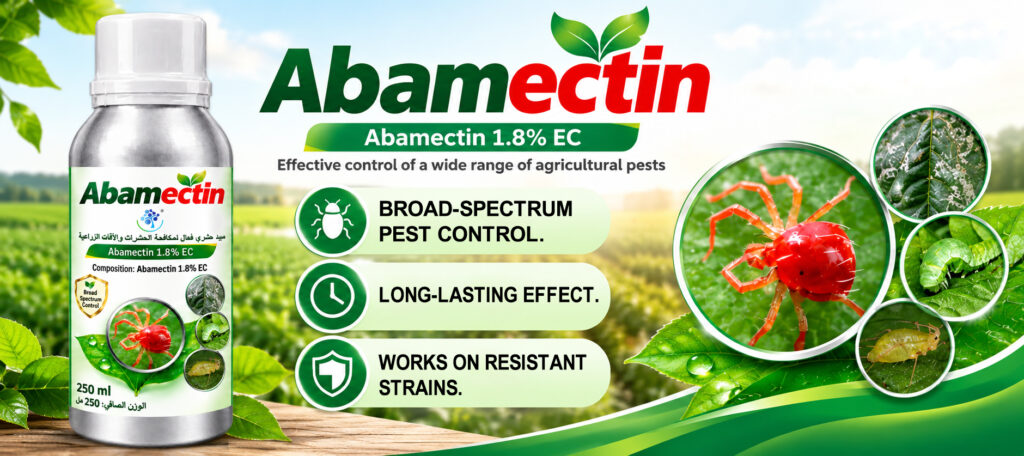
Abamectin is a natural fermentation-derived avermectin compound, belonging to a unique pesticide class with dual contact and stomach poison action. Unlike traditional pesticides that only kill surface pests, it features strong systemic absorption and leaf penetration capabilities. After field spraying, the active ingredient quickly penetrates crop foliage and remains inside leaf tissues, providing long-lasting protection against hidden pests that evade ordinary insecticides. Farmers and distributors can explore reliable formulations and technical specifications through our professional agrochemical product catalog to match different regional crop needs.
How Abamectin Works for Pest Control
Abamectin targets the nervous system of insects, mites, and nematodes by interfering with GABA receptor activity, blocking nerve signal transmission and causing immediate pest paralysis. Affected pests stop feeding and movement within hours after application and die completely within two to three days. Its unique translaminar penetration allows the chemical to move across leaf surfaces, effectively killing pests hiding on the leaf backside or inside leaf tissues, such as leaf miners and concealed mites.
One core advantage of abamectin is its low resistance risk when used properly. It performs excellently against pest populations that have developed resistance to pyrethroid and organophosphorus pesticides, making it an essential component in integrated pest management programs for commercial farms.
Target Pests and Applicable Crops
Abamectin covers an extremely broad pest spectrum, widely suitable for fruits, vegetables, cash crops, and field crops. Common controlled pests include spider mites, rust mites, aphids, thrips, whiteflies, leaf miners, and root-knot nematodes. It is extensively applied on citrus trees, mango trees, cotton, tomatoes, cucumbers, peppers, and tobacco crops.
For orchard farming, abamectin efficiently eliminates harmful mites that damage fruit surfaces and reduce commodity value. For vegetable plantations, it controls piercing-sucking pests that spread viral diseases. For bulk agricultural importers, its multi-crop adaptability makes it a versatile and high-demand product suitable for diverse regional planting environments in Africa and the Middle East.
Main Commercial Formulations and Market Advantages
The most mainstream market specifications include Abamectin 1.8% EC and high-content technical formulations. The 18g/L EC emulsifiable concentrate features easy dilution, uniform spraying, strong leaf adhesion, and stable efficacy under high-temperature and dry weather conditions, perfectly adapting to tropical and subtropical farmland climates.
Compared with other insecticides, abamectin provides three major benefits for B2B bulk buyers. First, ultra-low application dosage effectively reduces per-hectare pesticide cost for farmers. Second, strong translaminar penetration ensures stable efficacy even in hot weather. Third, it leaves moderate short-term residual effects without causing long-term soil pollution, safe for crop rotation and subsequent planting arrangements.
Professional Application Guidelines for Better Efficacy
To maximize field performance, spraying should be arranged during early morning or late afternoon, avoiding high-temperature noon periods that accelerate liquid evaporation. Uniform and thorough spraying is required to cover leaf surfaces and leaf backs completely. For severe mite or leaf miner infestations, tank mixing with compatible adjuvants can enhance penetration and improve pest elimination results.
To prevent pest resistance, it is recommended to alternate abamectin with pesticides of different chemical families instead of continuous single-agent use throughout the planting season. This scientific application method stabilizes long-term farm protection effects and reduces farmer input costs.
Why Source Bulk Abamectin from Professional Chinese Suppliers
Chinese agrochemical manufacturers provide high-purity abamectin technical materials and stable finished formulations that comply with international FAO standards. With mature production lines and sufficient inventory capacity, suppliers offer cost-effective container-scale bulk orders and flexible customized packaging solutions for global distributors.
We provide standard Abamectin 18g/L EC and customized specifications, complete with full export documents including COA, SDS, and registration support files. We support mixed container loading with other herbicides, fungicides, and insecticides to meet diversified procurement needs of regional agricultural importers. If you are looking for stable abamectin bulk supply, competitive wholesale prices, or professional crop protection technical support, visit our official website to get the latest product details and customized B2B quotation services.